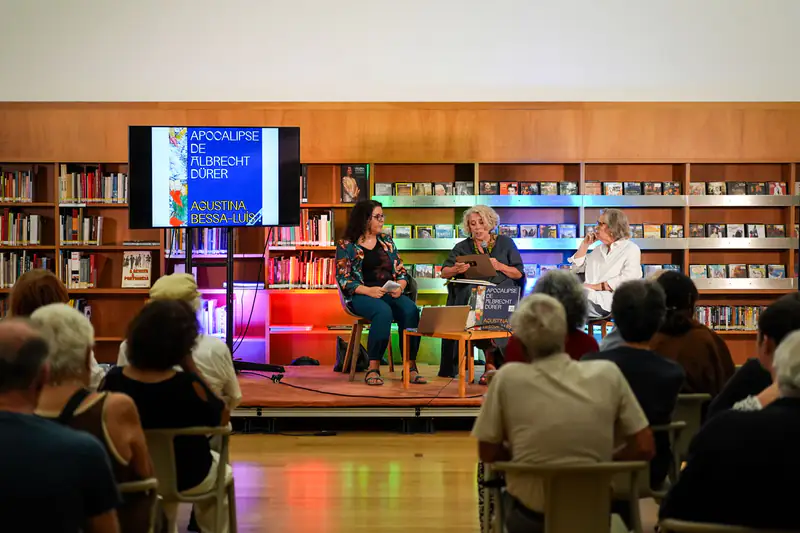
The Feira do Livro do Porto 2026 turned to the object that gives it its name to propel itself into parallel dimensions related to the book and inspired by it. Spanning more than 200 sessions, the programme – conceived and brought to life by playwright and actress Teresa Coutinho – set out in search of those “fleeting riches” referred to by Inês Lourenço, this edition’s honouree, in the verse that served as its motto, taken from the poem titled Epitáfio para um corpo.
Between 21 August and 6 September, there was room for talks, roundtables, and performances. Thematic cycles, book presentations, exhibitions, and concerts took form. New paths were forged and new formats discovered, without losing sight of traditions like the special edition of João Gesta’s Quintas de Leitura showcase or the presentation of the Tribute Tília, as part of a programme dedicated to the life and work of Inês Lourenço.
Notable among the new features were the more than 80 hours-worth of programming for children and youth, a record to date. It was complemented by a dedicated booklet listing each session and offering a series of activities encouraging the Feira’s youngest visitors to create, draw, and build. Playwriting also took centre stage in a new cycle dedicated entirely to this literary craft and which turned the spotlight towards figures such as Spanish playwright and director Angélica Liddell, the late Portuguese filmmaker João Canijo and the late Porto-born translator and essayist Paulo Eduardo Carvalho. But innovation was not confined to the grounds of the Palácio de Cristal Gardens; the Feira’s After-Hours was launched at the legendary Pinguim Café – a dedicated programme that extended the event into the night, in between friends and literature.
Within the performances, David Marques’ Labirinto combined a book launch with a DJ set and the performing arts. Within the talks, packed auditoriums listened to the conversations between writer and researcher Tatiana Salem Levy and anthropologist Leonor Rosas on the intersections between literary creation and gender-based violence; between poet and historian Ana Paula Tavares and poet and journalist Inês Fonseca Santos on collective memory and identity; and between philosopher and university lecturer Viriato Soromenho-Marques and essayist and professor Fátima Vieira on the ever-tenuous line separating utopia and dystopia. Within the roundtables, one of the most sought-after sessions was led by journalist Miguel Carvalho, featuring former Minister of Education João Costa, to discuss the global rise of populism.
In other formats, the public turned out in droves for the Fonoteca Municipal do Porto’s Hora de Ponta music club and for the book clubs organised by Livraria Aberta – the only exclusively queer bookshop in Portugal. The performance and dance cycle “Do timbre não o fundo, mas a fenda”, inspired by the literary world of Inês Lourenço, also caused quite the stir at the Carlos Alberto Chapel over the various weekends of the Feira.
In the end, the 17 days of the Feira do Livro do Porto were as fleeting as the soul-shaping sensations Inês Lourenço described in her poem. Fortunately, the Feira is set to resume its quest for those “fleeting riches” next year.